

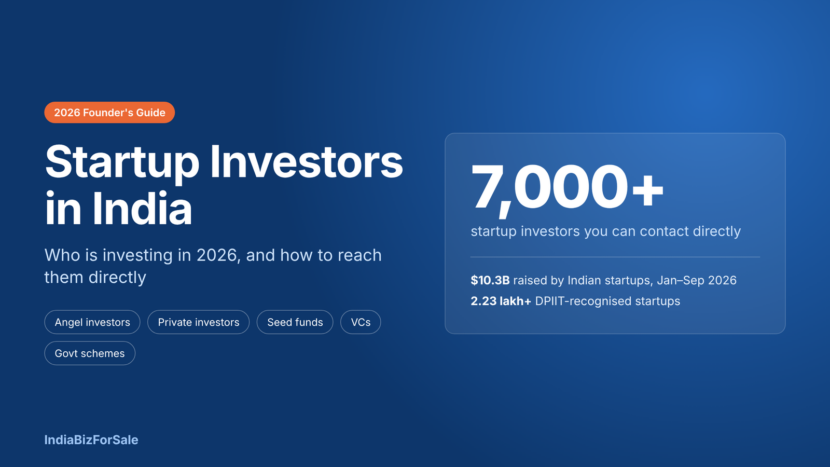
There are 7,596 startup investors from across India and abroad on IndiaBizForSale who are looking for growing startups to invest in, take a stake in, or partner with, and founders can contact them directly. They include business owners, HNIs, NRIs and professionals, and you can filter them by industry, city and budget. To find investors for your startup, shortlist 20-40 of them who already back your industry and region, get your deck and financials ready, and send a short, specific proposal. Beyond these private investors, startup funding in India in 2026 comes from angel networks, seed and venture capital funds such as Inflection Point Ventures, Blume Ventures, Titan Capital, 100X.VC and Peak XV Partners, and government schemes like the Startup India Seed Fund.
If you have typed “I need investors for my startup” into Google at 1 a.m., you are in good company. The government recognised more than 55,000 new startups in FY26 alone, and most of their founders hit the same wall: the product works, the first customers are paying, and the money to grow is not in the bank. If “looking for investors for my startup” is what brought you here, the rest of this guide walks through what the 2026 funding market looks like, which investor fits your stage, who is writing cheques, and how to reach them without waiting for a warm introduction.
How to find investors for startup funding in India: 4 steps
- Match the investor type to your stage and cheque size: angel, private business investor, seed fund, VC, or a government-backed scheme.
- Shortlist 20-40 investors who already back your industry and city, using a list of investors for startups you can filter by sector, location and budget.
- Get your pitch deck, financials and valuation in order before the first conversation.
- Contact investors directly with a short, specific proposal, and follow up with data.
Startup investment in India: key numbers for 2026
- $10.3 billion raised by Indian tech startups in January–September 2026, up 7% year on year (Tracxn)
- 1,134 funding rounds in the same period, down 38%. Fewer companies are getting bigger cheques
- Seed-stage funding: $698 million, down 37%. Early-stage funding: $4.2 billion, up 27%
- 2.23 lakh+ DPIIT-recognised startups as of 31 March 2026, with a record 55,200+ added in FY26
- ₹10,000 crore Startup India Fund of Funds 2.0, approved in February 2026
- 7,596 startup investors and buyers listed on IndiaBizForSale as of 29 October 2026
Raising capital for startup growth in 2026: what the numbers say
Headlines about startup funding swing between “funding winter” and “record year”. The 2026 numbers are more useful once you read them stage by stage.
According to Tracxn’s India Tech report for January to September 2026, Indian tech companies raised $10.3 billion, about 7% more than the $9.7 billion raised in the same period of 2025. The number of funding rounds, however, fell 38%, from 1,838 to 1,134. In plain terms, more money is going to fewer companies.
| Stage (Jan–Sep 2026) | Amount raised | Change vs Jan–Sep 2025 |
|---|---|---|
| Seed stage | $698 million | Down 37% (from ~$1.1 billion) |
| Early stage (Series A–B) | $4.2 billion | Up 27% |
| Late stage | $5.4 billion | Up about 4% |
| Total | $10.3 billion | Up 7% |
| Companies funded for the first time | 338 | Down 30% |
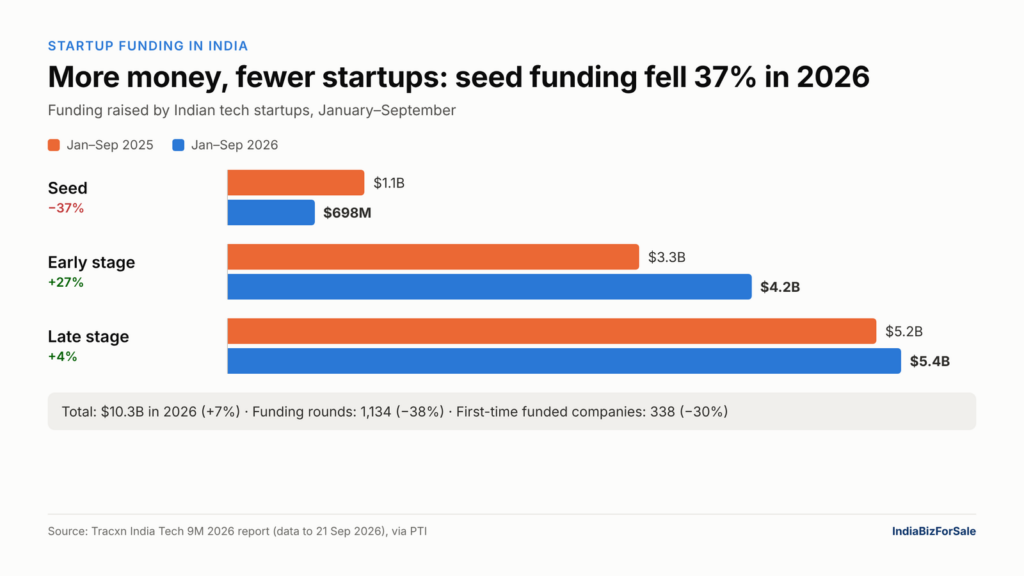
Source: Tracxn India Tech 9M 2026 report, as reported by Outlook Business / PTI, 24 September 2026.
Three things stand out for anyone raising capital for a startup today:
- Institutional seed funding for startups has tightened. Seed-stage money from tracked funds dropped by more than a third, and 30% fewer companies got their first-ever cheque. Angel activity tells the same story: Tracxn counted 834 angel deals in 2025, down from 1,495 in 2024 (Moneycontrol/Tracxn).
- Investors are writing bigger cheques to companies with proof. Early-stage funding grew 27%. If you have revenue, repeat customers or a working product, the market is more open than the headlines suggest.
- Capital is concentrated. Bengaluru alone took about 43% of 2026 tech funding (Tracxn via News Karnataka). A founder in Indore, Coimbatore or Jaipur has to look beyond the VC directories.
The supply side keeps growing too. DPIIT had recognised over 2.23 lakh startups by 31 March 2026, and nearly 48% of them have at least one woman director or partner (Inc42, citing DPIIT). That is a lot of founders competing for the same pool of seed capital, which is why where you look matters as much as what you pitch.
Which startup investors fit your stage?
Most rejections happen not because the business is bad but because the founder pitched the wrong kind of investor. A Series A fund will not look at a ₹40 lakh pre-revenue round, and an individual angel cannot lead a ₹50 crore growth round. Here is how the main types of investors for startups compare. Cheque sizes are typical ranges and vary from deal to deal.
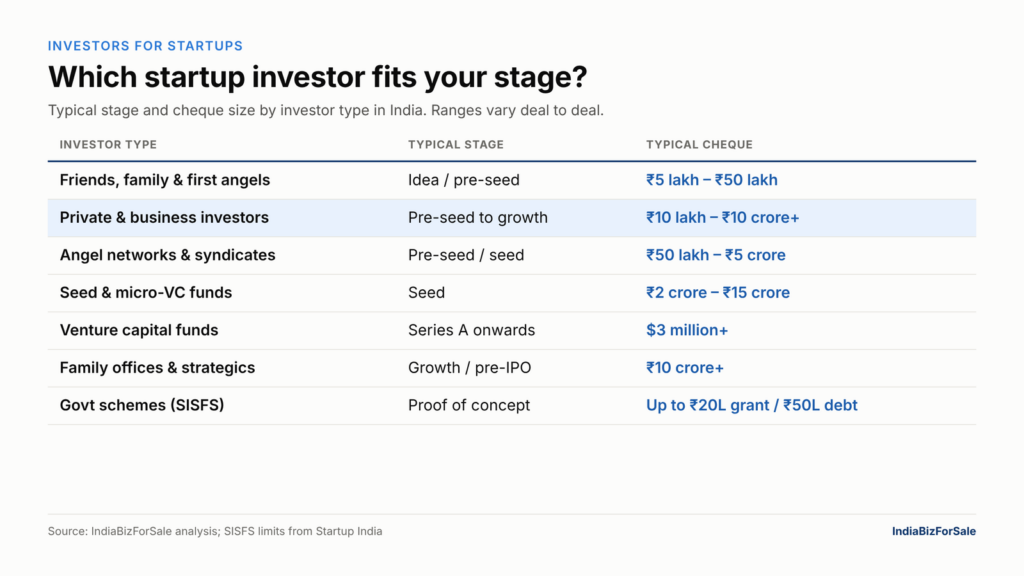
Typical stage and cheque size for each type of startup investor in India.
| Investor type | Typical stage | Typical cheque | What they look for |
|---|---|---|---|
| Friends, family and first angels | Idea / pre-seed | ₹5 lakh – ₹50 lakh | The founder, trust, early traction |
| Private investors and business investors (HNIs, business owners, NRIs) | Pre-seed to growth | ₹10 lakh – ₹10 crore+ | Sector familiarity, profitability, hands-on involvement |
| Angel networks and syndicates | Pre-seed / seed | ₹50 lakh – ₹5 crore (pooled) | Scalable model, clear market, clean cap table |
| Seed and micro-VC funds | Seed | ₹2 crore – ₹15 crore | Early product-market fit, team, large market |
| Venture capital funds | Series A onwards | $3 million+ | Repeatable growth, unit economics, path to scale |
| Family offices and strategic investors | Growth / pre-IPO | ₹10 crore+ | Strategic fit, governance, long-term value |
| Government-backed schemes | Proof of concept to early stage | Up to ₹20 lakh grant, up to ₹50 lakh debt/convertible (SISFS) | DPIIT recognition, incubator backing, innovation |
Private investors for startups: the most overlooked option
Most “top investors” lists only cover VC funds. That makes sense for a venture-scale tech company, but a large share of Indian startups are not built for venture capital, and they don’t need to be. A food brand, a clinic chain, a manufacturing unit, a logistics business or a regional software product often grows better with a private investor who understands the industry than with a fund looking for a 50x outcome. Many of the most useful investors for startup businesses in India are not funds at all.
These business investors for startups are usually business owners, senior professionals, HNIs or NRIs. Many have run companies themselves and prefer to back businesses they understand. They tend to decide faster, they often bring customers or suppliers along with the cheque, and they live across Tier-2 and Tier-3 cities where VC money rarely reaches.
The trade-off is that they are harder to find. There is no Tracxn page for a retired textile exporter in Surat who wants to put ₹2 crore into a D2C brand. That is the gap investor directories and deal platforms fill.
The 25 most active startup investors in India right now
If your startup is venture-scale, it helps to know who is actually writing cheques, not who was famous five years ago. The list below combines two data sources: Tracxn’s FY26 annual report, which named Inflection Point Ventures, Rainmatter and Venture Catalysts as the most active seed investors and Peak XV Partners, Accel and Lightspeed as the most active early-stage investors (Analytics Insight, citing Tracxn), and Funding Watcher’s activity ranking of VCs backing Indian startups, updated 26 October 2026.
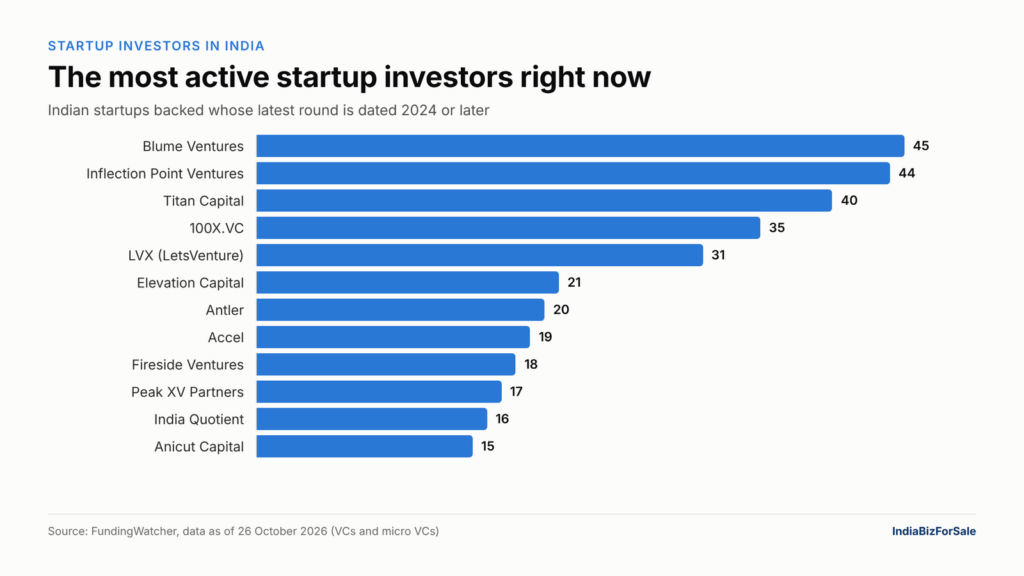
Most active startup investors in India by number of startups backed with a latest round in 2024 or later. Source: Funding Watcher, 26 October 2026.
| Investor | Type | Stage | Sector focus | Based in | Recent activity* |
|---|---|---|---|---|---|
| Inflection Point Ventures | Angel platform | Angel – seed | Sector agnostic | Gurugram | 44 |
| Blume Ventures | VC | Pre-seed – Series A | Deep tech, SaaS, consumer, climate | Mumbai | 45 |
| Titan Capital | Micro VC | Angel – seed | Consumer, SaaS, fintech, D2C | Gurugram | 40 |
| 100X.VC | Micro VC | Pre-seed – seed | Sector agnostic | Mumbai | 35 |
| LVX (formerly LetsVenture) | Investment platform | Angel – growth | Sector agnostic | Bengaluru | 31 |
| Elevation Capital | VC | Seed – Series B | Consumer, SaaS, fintech | Gurugram | 21 |
| Antler India | Pre-seed investor / company builder | Pre-seed | Sector agnostic | India programme (HQ Singapore) | 20 |
| Accel | VC | Seed – Series B | SaaS, consumer, fintech | Bengaluru (India office) | 19 |
| Fireside Ventures | VC | Seed – Series A | Consumer brands, D2C, food | Bengaluru | 18 |
| Peak XV Partners (formerly Sequoia India) | VC | Seed (Surge) – growth | Consumer, SaaS, fintech, health, AI | Bengaluru | 17 |
| India Quotient | VC | Pre-seed – seed | Bharat-first consumer, SaaS, vernacular | Bengaluru / Mumbai | 16 |
| Anicut Capital | Equity and private credit fund | Early – growth | Multi-sector | Chennai | 15 |
| 3one4 Capital | VC | Seed – Series A | Deep tech, SaaS, consumer, climate | Bengaluru | 14 |
| Dholakia Ventures | Family-backed venture investor | Early stage | Multi-sector | Surat | 14 |
| Omnivore | VC | Seed – Series A | Agritech, food, climate, rural | Mumbai | 13 |
| Kalaari Capital | VC | Seed – Series B | Consumer, SaaS, deep tech, health | Bengaluru | 12 |
| Z47 (formerly Matrix Partners India) | VC | Seed – Series B | SaaS, fintech, consumer | Mumbai | 12 |
| ah! Ventures | Angel network | Early revenue | Sector agnostic | Mumbai | 12 |
| The Chennai Angels | Angel network | Early stage | Agritech, EVs, deep science, health, fintech, D2C | Chennai | 12 |
| Stellaris Venture Partners | VC | Seed – Series A | SaaS, fintech, consumer tech | Bengaluru | 10 |
| Lightspeed India | VC | Seed – Series B | Enterprise, consumer, fintech | Bengaluru | 9 |
| Rainmatter (Zerodha) | Founder-backed fund | Seed – growth | Climate, health, fintech | Bengaluru | ₹1,500 cr in 160+ startups** |
| Speciale Invest | VC | Seed | Deep tech, spacetech, robotics, AI | Chennai | – |
| Venture Catalysts | Angel network / incubator | Pre-seed – Series A | Sector agnostic | Mumbai | – |
| Indian Angel Network | Angel network | Early stage | Sector agnostic | New Delhi | – |
*Number of Indian startups whose latest funding round is dated 1 January 2024 or later and that count this investor among their backers, per FundingWatcher (data as of 26 October 2026). “–” means the investor is not in that ranking, which covers VCs and micro VCs only. **Total deployed to date, per Business Today, April 2026. Sector and stage details are drawn from the investors’ public profiles and may change; always check the firm’s own website before you pitch.
Almost all of these firms accept applications through their websites. Expect a structured screening process and three to six months from first contact to money in the bank. Notice how many are in Bengaluru, Mumbai and Gurugram. If you are building outside those cities, or your business is not venture-scale, private investors are likely to be your faster route.
Seed funding for startups: government money you should know about
Seed capital for startups does not only come from private money. Three government changes in the last two years matter directly to founders:
- Startup India Fund of Funds 2.0 (₹10,000 crore). The Union Cabinet approved it in February 2026 and DPIIT notified the guidelines in April 2026. It does not fund startups directly. It invests through SEBI-registered AIFs, with a stated focus on deep tech, technology-led manufacturing and early-growth startups, and on taking capital beyond the metros. The first Fund of Funds (2016) backed 145 AIFs, which together invested over ₹25,500 crore in more than 1,370 startups (The Statesman; Drishti IAS). In practice, more domestic VC funds will have fresh money to deploy over the next few years.
- Startup India Seed Fund Scheme (SISFS). Through selected incubators, DPIIT-recognised startups can get up to ₹20 lakh as a grant for proof of concept or prototype, and up to ₹50 lakh through convertible debentures or debt for market entry and scale-up (Startup India Seed Fund).
- Angel tax is gone. The July 2024 Union Budget abolished the “angel tax” under Section 56(2)(viib) for all classes of investors, effective from assessment year 2025-26. Raising money from Indian angels and private investors above fair market value no longer carries that tax risk.
State startup policies in Gujarat, Karnataka, Kerala, Maharashtra, Tamil Nadu and others add their own seed grants and matching funds. Check your state’s startup portal before your first equity round, because grant money is the cheapest capital you will ever raise.
A list of investors for startups, state by state
Investors usually prefer businesses they can visit, so location still matters. The table below shows how many startup investors and buyers are currently listed on IndiaBizForSale in each state. Each link opens the full, filterable list for that state.
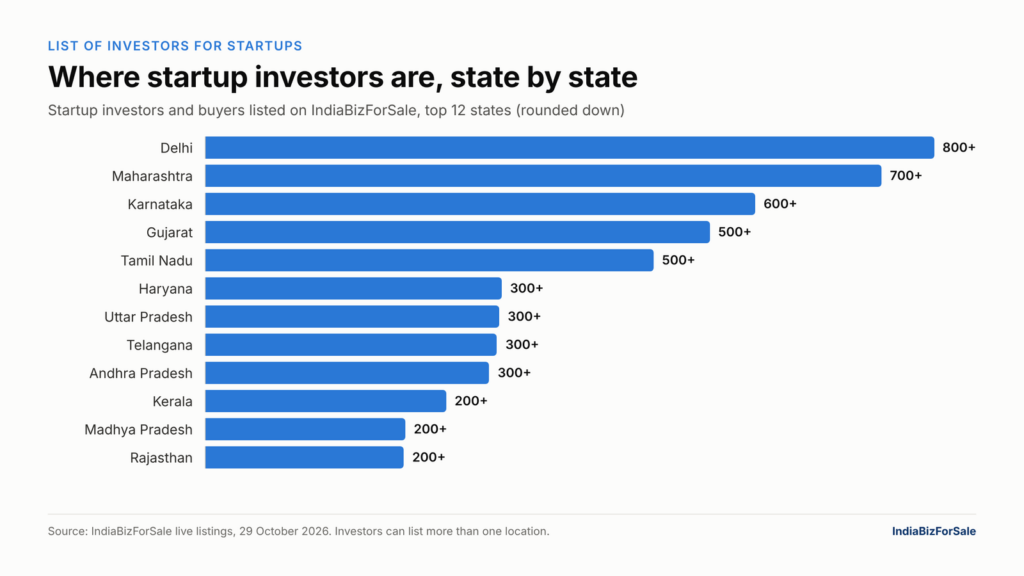
Startup investors listed on IndiaBizForSale in the top 12 states, 29 October 2026.
| State / region (startup investors list) | Startup investors listed* |
|---|---|
| Delhi | 800+ |
| Maharashtra | 700+ |
| Karnataka | 600+ |
| Gujarat | 500+ |
| Tamil Nadu | 500+ |
| Haryana | 300+ |
| Uttar Pradesh | 300+ |
| Telangana | 300+ |
| Andhra Pradesh | 300+ |
| Kerala | 200+ |
| Madhya Pradesh | 200+ |
| Rajasthan | 200+ |
| West Bengal | 200+ |
| Punjab | 100+ |
| Uttarakhand | 100+ |
| Goa | 100+ |
| Himachal Pradesh | 100+ |
| Bihar | 100+ |
| Odisha | 80+ |
| Jharkhand | 80+ |
| Chhattisgarh | 70+ |
| Assam | 50+ |
| Northeast: Sikkim, Manipur, Meghalaya, Mizoram, Nagaland, Tripura | 20+ each |
*Counts on IndiaBizForSale as of 29 October 2026, rounded down; the live numbers grow every day. An investor can list more than one preferred location, so state totals add up to more than the national figure.
IndiaBizForSale analysis: where founders face the least competition for investors
We compared the number of startup investors listed in each state with the number of DPIIT-recognized startups there. The result is a rough measure of how many startups compete for each investor’s attention. A lower number means less competition.
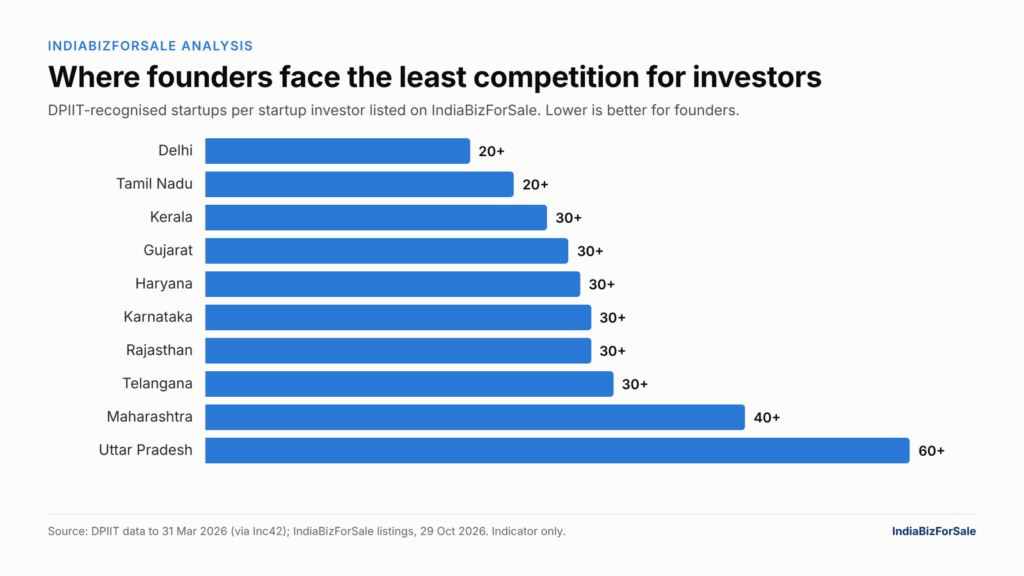
Startups competing for each listed investor, by state. Lower means less competition for founders.
| State | DPIIT-recognised startups (31 Mar 2026) | Startup investors listed on IndiaBizForSale | Startups per listed investor |
|---|---|---|---|
| Delhi | 21,120+ | 800+ | 24 |
| Tamil Nadu | 14,830+ | 500+ | 28 |
| Kerala | 8,620+ | 200+ | 31 |
| Gujarat | 19,270+ | 500+ | 33 |
| Haryana | 11,620+ | 300+ | 34 |
| Karnataka | 22,600+ | 600+ | 35 |
| Rajasthan | 8,100+ | 200+ | 35 |
| Telangana | 12,520+ | 300+ | 37 |
| Maharashtra | 38,660+ | 700+ | 49 |
| Uttar Pradesh | 21,960+ | 300+ | 64 |
Sources: DPIIT data for the top ten states as reported by Inc42; IndiaBizForSale investor counts as of 29 October 2026 (ratios use exact counts on that date; investor counts shown rounded down). This is an indicator, not a measure of total capital: not every recognised startup is raising money, and many investors invest across states.
Two things stand out. Delhi and Tamil Nadu founders have the most investors per startup, so a well-prepared proposal there faces less competition. Founders in Uttar Pradesh and Maharashtra face the most crowded field. For them it makes sense to widen the search to investors in neighbouring states and to NRI investors who invest across India. Maharashtra has a large investor pool, but it also has by far the most startups.
How to find investors for your startup and contact them directly
Knowing who invests is half the job. The other half is getting a real conversation. Here is the process founders on IndiaBizForSale follow.
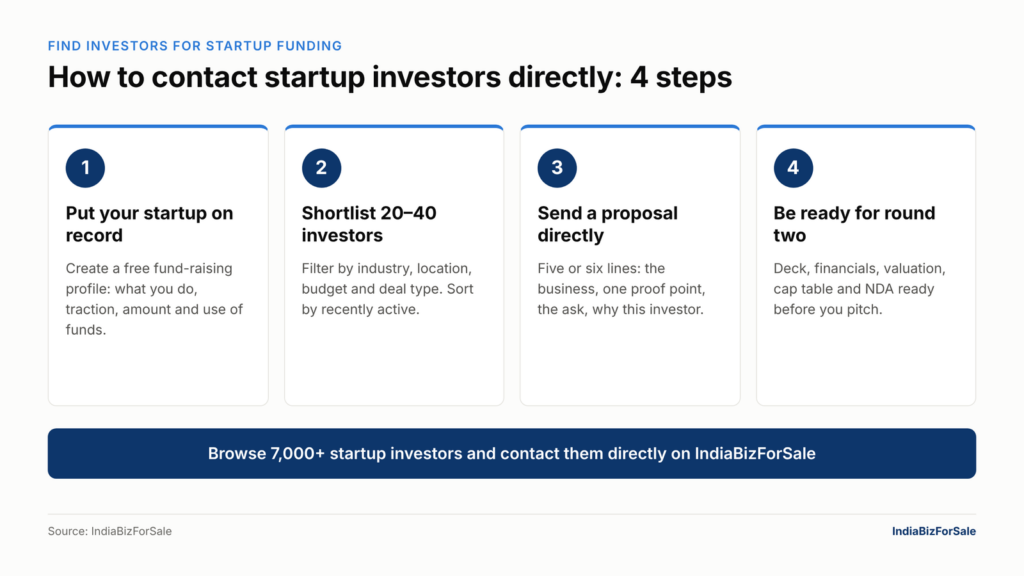
Four steps to find and contact startup investors directly.
Step 1: Put your startup on record
Create a free fund-raising profile for your startup. Cover what you do, who your customers are, your revenue or traction, how much you are raising and what the money is for. Investors scroll fast, so write the way you would explain the business to a smart friend: short sentences, real numbers, no jargon.
Step 2: Shortlist investors who already want what you have
Open the startup investors list and filter by preferred industry, preferred location, budget range and the kind of deal they want (equity, debt, partnership or acquisition). Sorting by “Recently Active” helps you focus on people who are looking right now. NRI and international investors interested in Indian startups can be found with the location filter. If your business is already profitable and you are open to a strategic partner, the wider business investors list is worth a look as well.
Aim for a focused list of 20 to 40 well-matched investors rather than 500 random ones. A specific proposal to the right person gets read; a mass email does not.
Step 3: Send a proposal and pitch directly
Click “Send Proposal” on an investor’s profile. Sending a proposal uses credits and unlocks the investor’s contact details, so you can talk to them directly without a middleman. Keep the first message to five or six lines: what the business does, one proof point (revenue, growth or a key customer), the amount you are raising, and why this particular investor is a fit.
Step 4: Be ready for the second conversation
Interested investors ask for detail quickly. Have these ready before you send the first proposal:
- A 10 to 12 slide pitch deck
- The last 2 to 3 years of financials (or monthly numbers if you are younger), plus 3-year projections with stated assumptions
- A defensible valuation. A free business valuation calculator gives you a starting point, and a formal valuation report helps in serious negotiations.
- A clean cap table, company registration and key contracts
- A signed NDA before you share sensitive data
“Even with the right investor, unclear business documentation delays deals.”
— Bhavin Bhagat, Co-founder, IndiaBizForSale
What makes investors say yes in 2026, and what makes them walk away
With fewer rounds and bigger cheques, investors have become more selective. Across angels, private investors and funds, a few things consistently move a conversation forward:
- Revenue or clear proof of demand. Early-stage funding rose 27% this year because investors are backing traction. Even ₹5 lakh a month in repeat revenue changes the tone of a meeting.
- A precise ask. “We are raising ₹1.5 crore for 18 months of runway to open two new cities” beats “we are open to investment”.
- Founders who know their numbers. Customer acquisition cost, gross margin, burn and runway, without opening a spreadsheet.
- Fit between investor and business. A private investor from the same industry often values your startup higher than a generalist would, because they can see risks and opportunities that others can’t.
- Speed and follow-through. Answering a data request in two days rather than two weeks is itself a signal.
And the things that quietly end conversations:
- A valuation that the numbers can’t support
- Projections with no assumptions behind them
- The same generic pitch sent to every investor on a list
- Messy ownership: undocumented early investors or co-founders without agreements
- Going silent for weeks after the first meeting
If you are investing in a startup instead
This page is also read by people on the other side of the table. If you are thinking about investing in a startup, a few basics protect you. Invest only money you can leave untouched for five to seven years. Spread it across several companies rather than one. Back sectors you understand, where you can add more than capital. Insist on proper documentation, including a shareholders’ agreement, valuation basis and clear information rights.
You can browse startups and businesses raising funds by industry, location and ticket size, and contact founders directly.
Frequently asked questions
How can I find investors for my startup in India?
Start by matching investor type to your stage: angels and private investors for pre-seed and seed rounds, seed funds and angel networks for venture-scale startups, and VCs from Series A onwards. Then shortlist investors who already back your industry and city using a filterable investor list such as IndiaBizForSale’s 7,500+ startup investors, prepare your pitch deck and financials, and contact them directly with a short, specific proposal.
Who are the most active startup investors in India in 2026?
By number of startups backed recently, the most active include Inflection Point Ventures, Blume Ventures, Titan Capital, 100X.VC, LVX (formerly LetsVenture), Elevation Capital, Antler, Accel and Peak XV Partners. Tracxn’s FY26 report named Inflection Point Ventures, Rainmatter and Venture Catalysts as the most active seed investors, and Peak XV Partners, Accel and Lightspeed as the most active early-stage investors.
I need investors for my startup but have no contacts. What should I do?
Warm introductions help, but they are not the only route. Investor platforms let you contact investors directly, angel networks such as Indian Angel Network, LVX and Venture Catalysts accept applications online, and government-backed incubators can open doors to the Startup India Seed Fund Scheme. A clear profile with real numbers works better than a large network.
Who are private investors for startups?
Private investors are individuals who invest their own money, such as business owners, HNIs, senior professionals and NRIs. They usually invest from ₹10 lakh to a few crore, often in industries they know, and can decide faster than institutional funds. They suit startups and growing businesses that are not chasing venture-scale returns.
How much seed funding can a startup raise in India?
Seed rounds in India commonly range from about ₹50 lakh to ₹15 crore, depending on traction, sector and investor type. Government support through SISFS offers up to ₹20 lakh as a grant for proof of concept and up to ₹50 lakh as debt or convertible instruments. In January to September 2026, total seed-stage funding in Indian tech was $698 million (Tracxn).
What is the difference between seed funding and seed capital for startups?
The terms are used interchangeably. Both refer to the first external money a startup raises, usually to build a product, prove demand or reach first revenue, in exchange for equity, convertible notes or, in the case of grants, no equity at all.
Is there still an angel tax on startup investments in India?
No. The Union Budget of July 2024 abolished the angel tax under Section 56(2)(viib) of the Income Tax Act for all classes of investors, effective from assessment year 2025-26.
How long does raising capital for a startup usually take?
Plan for three to six months from first outreach to money in the bank for a seed round, and longer for institutional rounds that need due diligence. Private investors who know your industry can move faster, sometimes within weeks, when documentation is ready.
Is it free to contact startup investors on IndiaBizForSale?
Creating your fund-raising profile and browsing the investor list is free. Sending a proposal to an investor uses credits, which unlock that investor’s contact details so you can speak to them directly.
Where to go from here
The 2026 numbers say the money is there, but it is going to founders who are prepared and who pitch the right people. If you are looking for investors for your startup, the most useful next hour you can spend is building a tight shortlist: 20 to 40 investors who already invest in your industry and region, plus a deck and financials you would be comfortable sending today.
Browse 7,500+ startup investors in India →
Need help with a larger raise, valuation or structuring? Our investment banking team at IBGrid works with founders on mandates of all sizes. Call +91 8000 422 133.
How we put this guide together
Funding figures come from Tracxn reports as published by the news outlets linked above. Startup counts come from DPIIT data. The active-investor table combines Tracxn’s FY26 rankings with FundingWatcher’s activity data (26 October 2026). IndiaBizForSale investor counts were taken from our live listings on 29 October 2026. We update this page every quarter when new funding data is released.
About the author
Bhavin Bhagat co-founded IndiaBizForSale in 2013. The platform connects business owners and startup founders with investors and buyers across India, and its advisory arm, IBGrid, works on fundraising and M&A mandates. [Add 1–2 lines on deal experience and a LinkedIn link.]
Reviewed by
Mayank Patel, Advisory Head, IBGrid. [Add 1 line on experience and a LinkedIn link.]
very nice hope we also get good investor
we are running baby brand
” Adriel Bringing Joy” from last 10 years
want to scale up
we are profitable brand want support to create an affordable good quality product baby brand in India.
any one kindly support us
Anil Singh
9810370417
[email protected]
Thank you for sharing your details. Our team will connect with your shortly.
Hi we are running travel agency in Delhi, NCR, from last 3 years.
want to scale up and expand our business with marketing and tie-ups, we have profitable plans.
looking for some investors to get funded.
Anup
9873-177-927
[email protected]
Hello Mr. Anup,
You can create your business proposal (FREE) on our platform at http://www.indiabizforsale.com and start connecting with relevant investors directly to complete your business funding transaction.
Check how it works here: https://www.indiabizforsale.com/business/fund-raising-financing-businesses
Best,
IndiaBiz team.
Hello Dear
I am an investment facilitator. Apparently, I work for a local investor in the United State. Currently, they are seeking to invest in viable companies in your country. Please get back to me if your Project is still available. [email protected]
Yours Sincerely,
Ms. C. Rose.
Thank you for sharing the details, our team will reach out to you directly. In the meantime, you can explore our platform and connect with suitable businesses directly, check here: https://www.indiabizforsale.com/business/business-opportunities-for-sale
Dear investors
My name’s Tiago Intela and I am looking for investors for my startup. I entend to open a small startup company. Ideally the business will be cleaning mining desktop/laptops/servers at our mining companies. Here this business is lucrative and no startup has been built up for this purpose. I would be the first one. Please i need your support and get the way forward to getting this dream of mine real.
Thank you so much for your support. I have share my email address.
Regards
Tiago Intela
Thank you for sharing the details, Our team will reach out to you via email.
Get me your Pitch Deck with Financials @ [email protected]
You can create your profile on our platform to connect with right matches directly. Check here: https://www.indiabizforsale.com/
Finding the right investor is rarely just about finding someone willing to write a cheque, it’s about finding someone who understands the journey you’re building.
This article is useful because it highlights an important part of fundraising that founders often underestimate: knowing who to approach and why. Having a list of investors is one thing, but understanding their investment focus, stage preference, sector interests, and expectations can make the outreach far more meaningful.
A strong pitch needs more than a compelling story, it needs clear traction, realistic projections, a defensible financial model, and answers to the questions an investor is likely to ask.
Thank you for your comment.