

You have spent 25 or 30 years building the business. You know every machine on the floor, every supplier by name, and which customers pay on time and which need a phone call.
Your son has a career in Bengaluru, or Dubai, or Toronto. Your daughter has built her own life. Both are doing well, and you are proud of them. Neither of them wants to come back and run the company.
So what happens now?
I have had some version of this conversation with business owners more times than I can count. Usually it comes up late in the meeting, after we have talked about revenue and buyers and valuation. There is a pause, and then the owner says something like, “Actually, the real issue is that my children are not interested.”
If this is where you are, I want to say something first: this is not a failure, and you are not the only one. It is one of the most common situations a family business owner in India will face. There are more ways forward than most people realize.
When the next generation says “I don’t want it”
That sentence can mean very different things, and it is worth finding out which one you are hearing before deciding anything.
Sometimes it means “I don’t want to work under you.” Many capable sons and daughters are not rejecting the business. They are rejecting the idea of spending their thirties as the junior person in their parent’s office, where every decision is still made by the parent.
Sometimes it means “I want to build something of my own first.” That is very different from “never.”
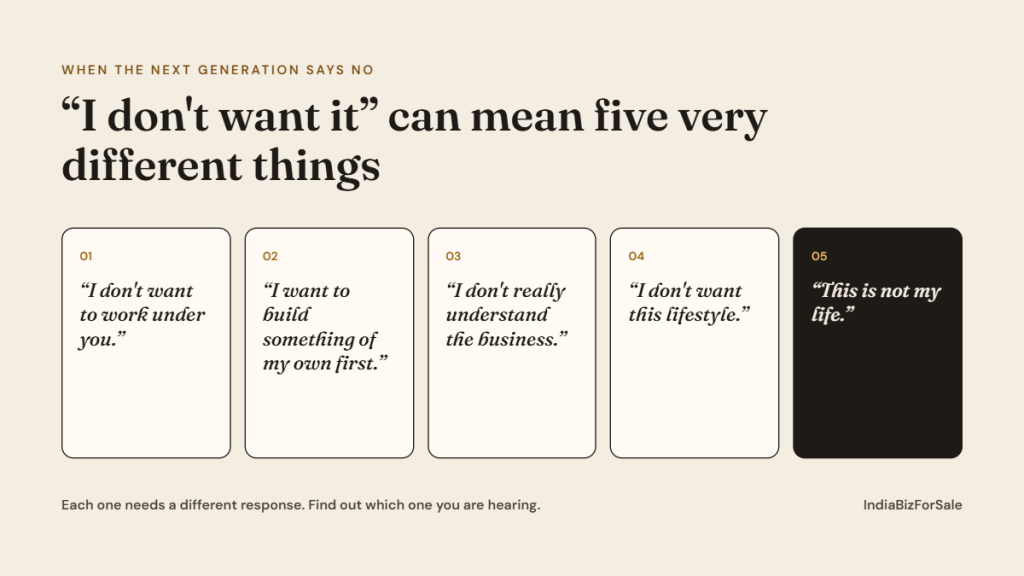
Sometimes it means “I don’t actually understand the business.” The child grew up hearing about problems at the dinner table but was never given a real role, real information or real authority.
Sometimes it means “I don’t want this lifestyle.” That can mean the 12-hour days, the cash-flow worry, and the phone ringing on Sunday because a truck is stuck at a checkpoint.
And sometimes it genuinely means “This is not my life.” They have a career they love, they live abroad, and they are not coming back.
Each of these needs a different response. The first may be solved by changing how the business is run. The second may be solved by time. The last one should be respected.
A study by KPMG in India with CII makes a similar point from both sides. Senior family members often believe the next generation lacks interest. The next generation often points to the senior generation’s reluctance to step back, and to one-sided communication that leaves them feeling like outsiders. Both sides can be right at the same time.
What the research actually says
It helps to see where your situation fits in the bigger picture, so here is what the recent research says.
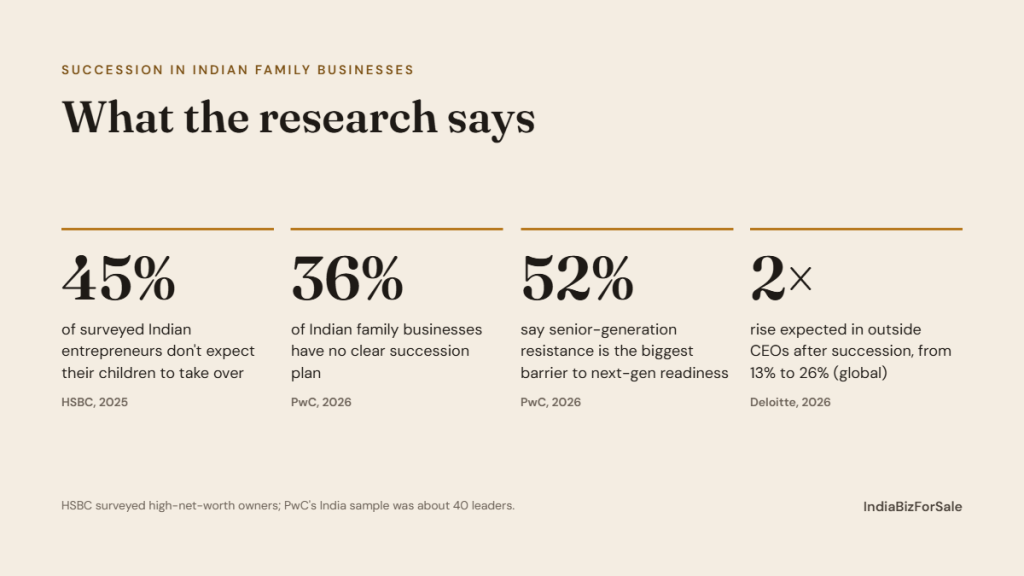
HSBC’s 2025 study found that 45% of the Indian entrepreneurs surveyed do not expect their children to take over the family business. The figure was higher among first-generation owners (55%) than among multi-generation families (35%). That makes sense. If you built the business yourself, your children grew up watching a startup, not an institution. A few other findings from the same study:
- Only 7% of Indian second- and third-generation owners said they had felt obligated to take on the family business.
- 83% said they had felt free to pursue other interests when they first took over.
One caveat: this survey covered high-net-worth business owners with at least US$2 million in investable assets, across ten markets. It tells us something real about attitudes, but it is not a survey of every SME owner in India.
PwC’s latest Family Business Survey, published in January 2026, looks at the planning side:
- 36% of Indian family businesses have no clear succession plan (28% globally).
- 21% have delayed the transition because of uncertainty (10% globally).
- 52% say resistance from the senior generation is the biggest barrier to next-generation readiness (29% globally).
The PwC report also contains a finding I found telling. Lack of interest from the next generation in joining the business was cited by 27% of Indian respondents, against 43% globally. The India sample is small, around 40 family business leaders, so I would not build a theory on it. But it matches what I see. In many Indian families, the bigger obstacle is not that the children are unwilling. It is that nobody has had the honest conversation, and the senior generation is not ready to let go. (PwC’s press release has a shorter summary of the findings.)
Deloitte Private’s 2026 global succession report adds one more point. Among the family businesses it surveyed, the share with an outside professional as CEO is expected to double after succession, from 13% to 26%. These are mostly large companies, but the direction is clear: families are increasingly separating who owns the business from who runs it.
What we see on IndiaBizForSale
Our own platform gives us a different, more ground-level view.
As of 24 September 2026, IndiaBizForSale has more than 16,900+ businesses and business opportunities listed. Of those owners who are seeking an exit, around 60% have cited succession-related reasons, most often the next generation not taking over, as part of why they are exploring a sale.
What it does tell me is this. Among owners who are actively looking at an exit, succession is not a side issue. It is often the main one.
You can see it in the listings themselves:
- an auto components manufacturer in Pune, running since 1985, where most of the 200 employees have been with the company for over 20 years. The founders want to retire, and the next generation is settled abroad.
- a 50-year-old sweets and namkeen business in Yavatmal, run by four brothers since 1978, with two retail outlets and 100 mithai makers, bakers and staff. The next generation is not interested in taking it forward.
- a 70-year-old owner of an Ahmedabad transport business whose next generation is settled in the UK
- an educational institute in Bikaner, built since 2002 into a campus of over 3,300 students. The promoter is dealing with health reasons, and here too the next generation is not interested.
- an 82-year-old promoter of a battery manufacturing company with no one to take it forward
- and many more…..
None of these were failing businesses. They had simply reached a point where the family’s next chapter and the business’s next chapter were going in different directions.
I have been on the other side of this table
Priya and I did not start IndiaBizForSale as advisers. We started it as sellers who had a hard time.
In 2006, our family entered a joint venture in a pharmaceutical manufacturing unit in Roorkee. By 2010, the partnership had broken down and we needed to exit.
Our reason was not succession. It was a partnership that stopped working. But the experience of trying to sell a running business in India taught us things I still think about in every conversation with an owner:
- Investment bankers were not interested because the deal was too small.
- Brokers wanted money upfront with no guarantee.
- Everyone had a different opinion on what the business was worth.
- We were constantly worried that employees, customers or competitors would find out before we had a plan.
We eventually found a buyer. What stayed with me was that selling a business is rarely just about the business. It is about the people who work there, the family’s reputation, and the feeling of handing over something you built. That is even more true when the reason for selling is that your own children have chosen a different path. (Our story has more on how that experience led to IndiaBizForSale.)
Your business doesn’t have to end because your child doesn’t want it
This is the most important idea in this article, so I will say it plainly.
Not having a successor, or having a child who doesn’t want to run the business, does not mean the business has failed.
A good business has value that exists independently of who runs it:
- customers who come back
- employees who know the work
- supplier relationships and distribution reach
- a brand people recognise in its market
- cash flow
- sometimes licences, technology or a location that took years to secure
None of that disappears because your son is a software engineer in Pune, or settled abroad.
So the question changes. It is no longer “My children don’t want my business, now what?” It becomes “Who should own and run this business next, so it keeps doing well?” The answer might still include your family. It might not.
Family ownership and family management are two different things
Your daughter might say, “I don’t want to run Dad’s factory.” That doesn’t necessarily mean, “I don’t want the family to own the factory.”
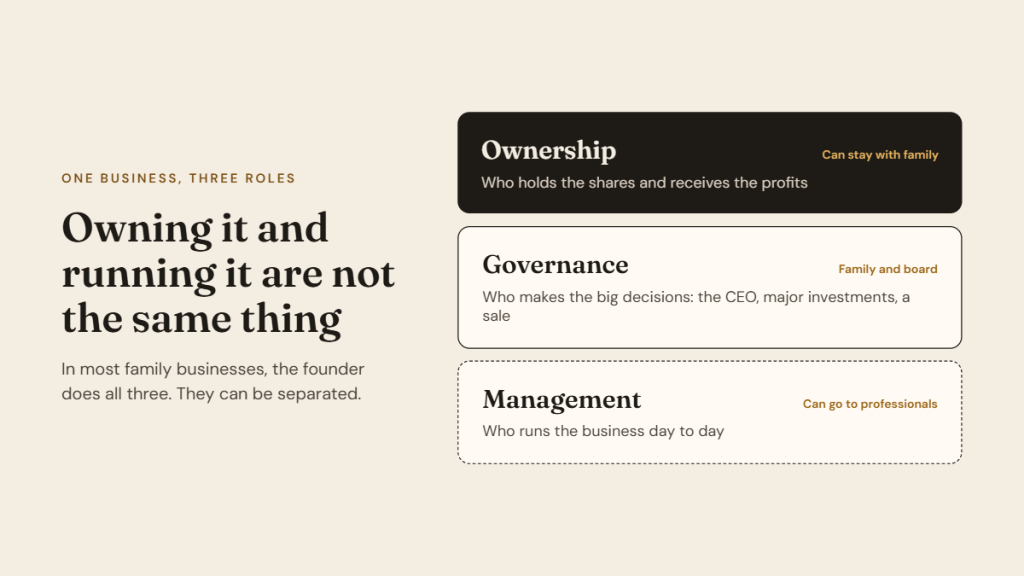
A business has several layers:
- Ownership: who holds the shares and receives the profits.
- Governance: who sits on the board and makes the big decisions, such as appointing the CEO, approving major investments, or deciding whether to sell.
- Management: who runs the business day to day.
In most Indian SMEs, one person does all three, and that person is the founder. That’s why “my child won’t run it” feels like “the business ends with me.”
But these roles can be separated. A child who does not want to manage can still be an owner, still sit on the board, and still protect the family’s interests, while professionals run operations.
If Children Don’t Want the Family Business.. You have 7 Options
Option 1: Give the next generation time
If the “no” is really a “not now,” time can change things.
Many families now ask children to work outside the business first, and this is increasingly deliberate. Deloitte’s 2026 report found that 40% of family businesses it surveyed require outside work experience before a family member joins. A few years elsewhere can give a son or daughter confidence, credibility with employees, and a genuine choice rather than an obligation.
KPMG’s research in India describes another approach some families use: setting aside a separate corpus, or using a family office, to back the next generation’s own ventures. The child builds something of their own while staying connected to the family’s business and wealth.
There is also a well-known public example of how things can change. Bisleri’s chairman, Ramesh Chauhan, had publicly said his daughter Jayanti was not interested in handling the business, and the company held sale talks with Tata Consumer Products. Those talks ended in March 2023. Afterwards, Chauhan said Jayanti would run the company with the professional team led by CEO Angelo George, and that the family did not want to sell. I mention this not to suggest your child will change their mind, but to show that “not interested” is sometimes a stage rather than a final answer. It also shows a family member leading alongside a professional management team, which is a structure worth thinking about.
The risk with this option is waiting without a deadline. “Let’s see in a few years” is fine if you are 55 and healthy. It is a much bigger gamble at 72.
Option 2: Professionalize the business
Before you can hand over management, the business has to be able to run without you. For many owners, this is the hardest part to hear, because the honest answer is often that it can’t yet.
Professionalising usually means building a second line of management who can make decisions, not just follow instructions. It means:
- a proper finance function
- monthly reports you actually read
- documented processes
- customer relationships held by the company, not just by you personally
- often an advisory board or a couple of independent directors who can tell you uncomfortable things
This takes time, usually a few years rather than a few months. The good part is that it is valuable whatever you decide later. A professionally run business is easier to hand to a family member, easier to hand to a hired CEO, and easier to sell.
Option 3: Keep ownership in the family, bring in professional management
Once the business can run without you, the family can remain the owner while a professional CEO or general manager runs operations. The children become owners and board members, not managers.
This works best when:
- the business is large enough to pay for good management
- reporting is clean enough for owners to supervise from a distance
- the family agrees on what it wants from the business
It gets harder when the children live abroad and have no time or interest in overseeing a manager. It also gets harder when siblings disagree about dividends, reinvestment or who has the final say.
Structures like family trusts, shareholder agreements and family constitutions come up here. I won’t go into the legal and tax details, because they depend entirely on your situation. Please work them out with a qualified lawyer, tax adviser and chartered accountant before you commit to anything.
Option 4: Bring in a strategic partner
Sometimes the real problem is not ownership but operational capacity. Nobody in the family wants to run the business day to day.
A strategic partner can solve that without a full sale. This could be an industry player, an operating partner, a minority investor or a joint venture. We had a hydraulic systems manufacturer on our platform whose promoter, because of a succession gap, was looking specifically for a working partner to handle operations and manufacturing. He wasn’t looking for someone to write a cheque.
The right partner brings something the business lacks: management depth, capital, new markets, technology or distribution. The trade-off is that you share decisions, and that requires trust and a clear written agreement on roles, control and what happens if the partnership doesn’t work.
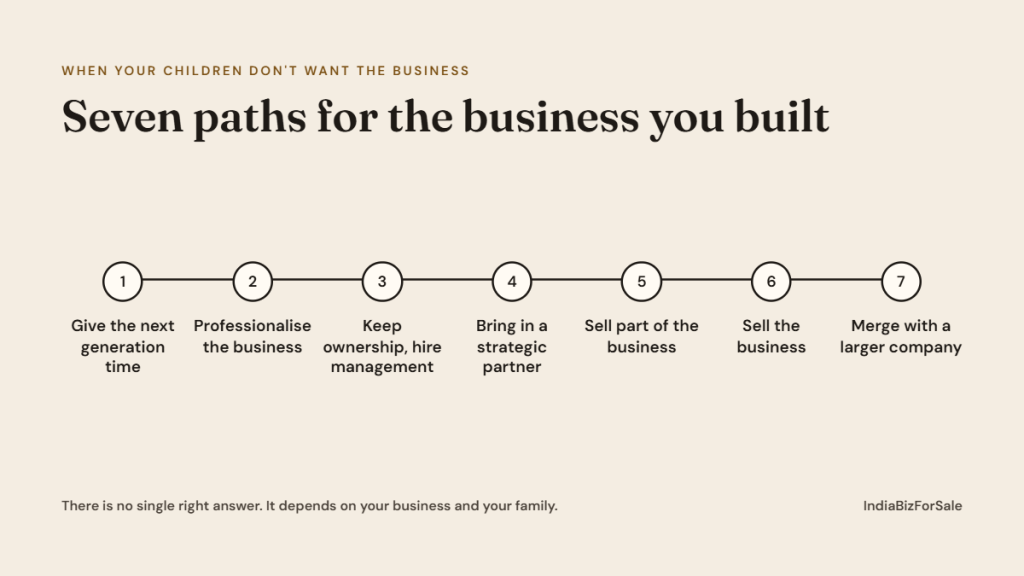
Option 5: A partial exit
Owners often think the choice is between keeping everything and selling everything. There is a lot of space in between.
A partial exit might mean selling a minority or majority stake now, taking some money out for the family’s security, and staying on for a few years to support the transition. It might mean selling to an investor who brings in professional management while you remain a shareholder. Or it might be staged: part now, part later, based on how the business performs.
This can suit owners who want financial security and a successor for the business, but aren’t emotionally ready to walk away on day one. The structure matters a great deal here, so get proper advice before you sign anything.
Option 6: Sell the business
For many owners, a full sale is the cleanest answer. It is not a defeat. It can be the most responsible decision you make for the business, your employees and your family.
Buyers come in different forms:
- a competitor who wants your customers or capacity
- a company in an adjacent business
- a larger group entering your region
- a financial investor backing a professional management team
- an individual entrepreneur who would rather buy a running business than start one
Here is something I tell every owner: the right buyer is not always the one offering the highest number. You may also care about what happens to employees who have been with you for 20 years, and whether the brand and your family’s name are treated with respect. You may care whether the buyer can actually run the business, how long you are expected to stay during the handover, and whether the process stays confidential until you are ready. These are legitimate priorities, and it is fine to weigh them.
If you want to see what a sale looks like in practice, here is how a 68-year-old Ahmedabad family logistics business found its buyer, and our step-by-step guide on how to sell a business in India.
Option 7: A merger or strategic combination
Sometimes the best future for a business is as part of a larger one. In a merger, two businesses combine. Your family might end up holding shares in a bigger company instead of owning a smaller one outright. Or your business might become a division of an acquirer that already has the management depth yours lacks.
This can make sense when your business is strong in one area (a product, a region, a customer segment) but would struggle to grow alone. The combined business may be worth more than the two separately, because each fills the other’s gaps.
What the business needs from its next owner
Most owners ask, “Who will inherit my business?” A more useful question is, “What does this business need next, and who can provide it?”
Maybe it needs capital to expand capacity. Maybe it needs professional management, or technology the current team can’t build. Maybe it needs access to new markets, or someone with industry depth who can take it beyond one city.
Sometimes the honest answer is that your children, even if they were willing, would not be the best people to provide these things. And sometimes the answer points to a partner or buyer who has exactly what’s missing. Framing it this way takes some of the emotion out of the decision. You are not choosing between your children and a stranger. You are choosing what gives the business its best next chapter.
What to prepare, whatever you decide
Whichever path you choose, the same preparation makes the transition easier. It can also affect how much the business is worth to a buyer, partner or successor. I would start on these early, ideally years before you need them.
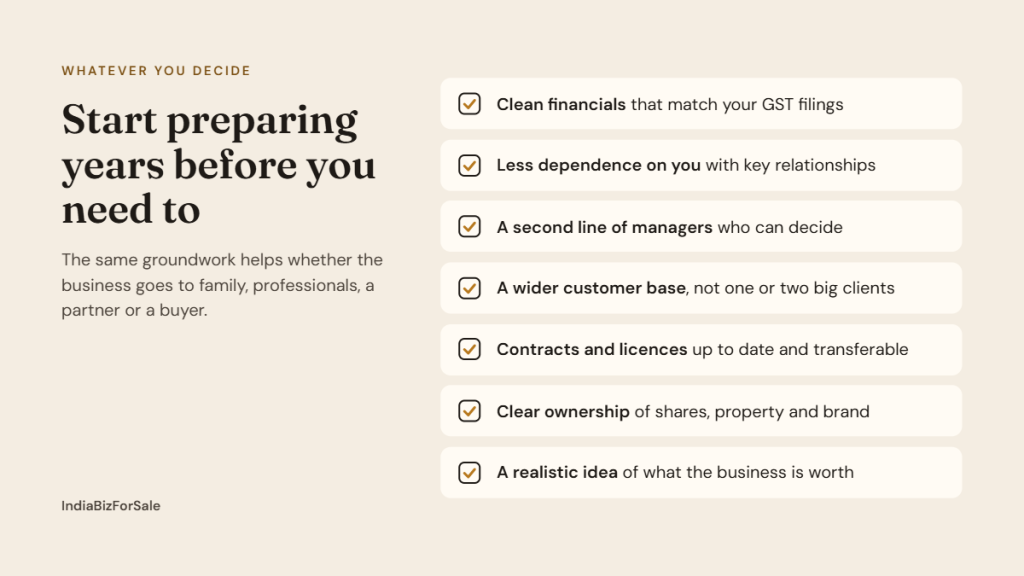
Clean financials.
This means audited accounts, GST filings that match the books, no unrecorded cash, and personal expenses kept separate. Messy numbers are one of the most common reasons buyers lose confidence or reduce their offer.
Less dependence on you.
If every major customer, supplier and banker deals only with you, the business is harder to transfer, whoever the successor is. Start handing over relationships now.
Management depth.
Identify and develop two or three people who can run key functions without you.
Customer concentration.
If one or two customers make up most of your revenue, a buyer will see that as risk. Broadening your customer base takes time.
Contracts and compliance.
Check that leases, supplier agreements, licences and statutory filings are up to date and actually transferable.
Ownership clarity.
Know exactly who owns what: shares, property, brand names, and any assets sitting in a family member’s name.
Realistic expectations about value.
Know what the business is likely to be worth before the family makes decisions based on a number that exists only in someone’s head.
A word on valuation
When I ask an owner what they think the business is worth, I often hear an answer rooted in history: “I’ve put 30 years into this.” I understand that completely. But a buyer or investor is looking forward, not backward. They are asking what the business will earn in future and how risky that is.
That depends on things like:
- revenue and how stable it is
- profitability and cash flow
- growth
- how many customers you depend on
- whether revenue is recurring
- how dependent the business is on you personally
- the strength of the team
- assets and liabilities
- the industry and current market conditions
- what a particular buyer gains by combining your business with theirs
There is no single formula that applies to every business, and I would be wary of anyone who gives you a number without studying yours properly. Our guide on how to value your business for sale in India goes deeper into how buyers think about this. What the business means to you and what the market will pay for it are both real. They are just not the same number, and the sooner the family understands the difference, the better the decisions will be.
Five mistakes I see owners make
Forcing a child into the business.
A reluctant successor, running something they never wanted, rarely does well by the business or by themselves. Responsibility works best when it is chosen.
Waiting until retirement, or until a health scare.
Options narrow quickly when an owner is suddenly unable to run the business. A 60-year-old can choose any of the paths above. A family dealing with an emergency usually has far fewer choices, and less negotiating strength.
Assuming only family ownership preserves the legacy.
A business can continue under new ownership with its employees, brand, customer relationships and culture intact, sometimes with the founder staying involved for a while. Legacy is what the business keeps doing, not only whose name is on the share certificate.
Setting the price from emotion.
An asking price based on sacrifice rather than performance usually leads to months of silence from buyers, and then a discouraged owner who concludes “nobody wants my business.” Often the business was fine. The price wasn’t.
Telling everyone before there is a plan. Word travels fast in Indian business circles. Employees get anxious, key people start looking elsewhere, competitors call your customers, and suppliers tighten terms. Keep the early conversations to family and trusted advisers until you know which direction you are going.
A simple way to think about your situation
These questions won’t give you the answer, but they will make the conversation with your family and advisers much clearer.
- Does my child dislike the business, or just not want to run it right now? Have you actually asked, clearly, and listened to the answer?
- Could the business run for three months without me? If not, that is your first project, whatever you decide.
- Would professional management solve the problem? Is the business large and organised enough to attract and pay for good managers?
- Would a strategic partner help? Is what’s missing capital, management, markets or technology?
- Would a partial transition make sense? Do I want some security now, while staying involved for a while?
- Would a full sale give the cleanest transition? For the business, the employees and the family?
- What matters most to me? Price, continuity, employees, legacy, family wealth, speed, confidentiality or control? Every owner ranks these differently, and there is no wrong order. But you need to know your own order before you can judge any offer or plan.
One thing I would tell you if we were sitting across the table
Don’t confuse your child’s decision with the value of what you built.
When a son or daughter says they don’t want the business, many owners hear, “What you spent your life on doesn’t matter to me.” That is almost never what they mean. Usually they mean they have their own life to build, which is exactly what you worked for.
What you built still matters: the jobs, the customers, the reputation, the cash flow. It deserves a proper next chapter, whether that is with your family, with professional managers, with a partner, or with a new owner who will take it further than you could have alone.
There is no single right answer
I am not going to tell you to sell. For some families, the right path is giving the next generation more time. For others, it is professional management, a partner, a partial exit or a full sale. The right answer depends on your business, your family and what matters most to you.
What I have seen, again and again, is that the owners who handle this well start early. They have the honest conversation with their children while there’s still time to act on the answer. They clean up the business while nothing is forcing them to. They explore their options calmly rather than in a crisis.
If you are at this stage, a sensible start is getting a rough sense of value (IBGrid’s business valuation calculator is one quick starting point), speaking with a CA and lawyer you trust about structure, and learning what kinds of buyers, investors or partners exist for a business like yours. IndiaBizForSale is one place where owners can confidentially see that side of the market before deciding anything.
The important thing is to start the conversation early enough that you still have choices.
Key takeaways
- A child not wanting to run the family business does not mean the business has failed or must close.
- Ownership, governance and management can be separated. The family can own the business while professionals run it.
- The seven main options are: give the next generation time, professionalise, keep ownership with professional management, bring in a strategic partner, sell part of the business, sell it fully, or merge with a larger company.
- In PwC’s 2026 survey, 36% of Indian family businesses had no clear succession plan.
- On IndiaBizForSale, around 60% of owners seeking an exit cite succession-related reasons (platform data, 24 September 2026).
- Start preparing years ahead: clean financials, less founder dependence, a second line of managers and realistic value expectations.
Questions owners often ask me
What should I do if my children don’t want to take over the family business?
First, find out exactly what they mean. Not wanting to run the business today is different from never wanting any involvement. Then check whether the business can run without you, and look at your options: more time, professional management, a strategic partner, a partial exit, a full sale or a merger.
My son doesn’t want to take over the family business. Should I force him?
Generally, no. A reluctant successor rarely does well for the business or for themselves. Have an honest conversation about whether he doesn’t want to run the business or doesn’t want to be involved at all. He may still be willing to stay an owner or board member while professionals manage operations.
Can I keep the family business without my children running it?
Yes. Ownership and management can be separated. The family can remain the owner and sit on the board while a professional CEO or general manager runs day-to-day operations. This works best when the business has good reporting and a capable management team.
Should I sell my family business if my children aren’t interested?
Not automatically. Selling is one option among several. It can be the right choice when no one in the family wants operational or ownership responsibility, or when a buyer can take the business further. The decision depends on your priorities: price, employees, legacy, control and timing.
Can I sell only part of my family business?
Yes. Owners can sell a minority or majority stake, bring in a strategic investor, or plan a staged exit while staying involved for a period. The right structure depends on your situation, so get legal, tax and financial advice before agreeing to terms.
How do I prepare my family business for succession?
Clean up financials and compliance, reduce dependence on yourself, develop senior managers, broaden your customer base, clarify ownership, and get a realistic view of value. These steps help whichever option you eventually choose, and are best started several years in advance.
How do I find a buyer for my family business in India?
Buyers include competitors, companies in related industries, financial investors, and entrepreneurs looking to acquire a running business. Confidentiality matters, so owners often work with advisers or use confidential business-for-sale platforms like IndiaBizForSale rather than announcing a sale openly.

Bhavin Bhagat
Co-Founder & CEO at IndiaBizForSale and IBGrid