

Be honest with yourself for a moment.
Is your business listed and getting no serious interest? Are buyers going quiet after the first conversation? Is the sale taking much longer than you expected?
That is not bad luck. That is one of these five mistakes, working against you right now, today, without you realizing it.
We have helped thousands of business sellers on IndiaBizForSale close deals fast and at the right price. The ones who struggled all had something in common. So did the ones who succeeded.
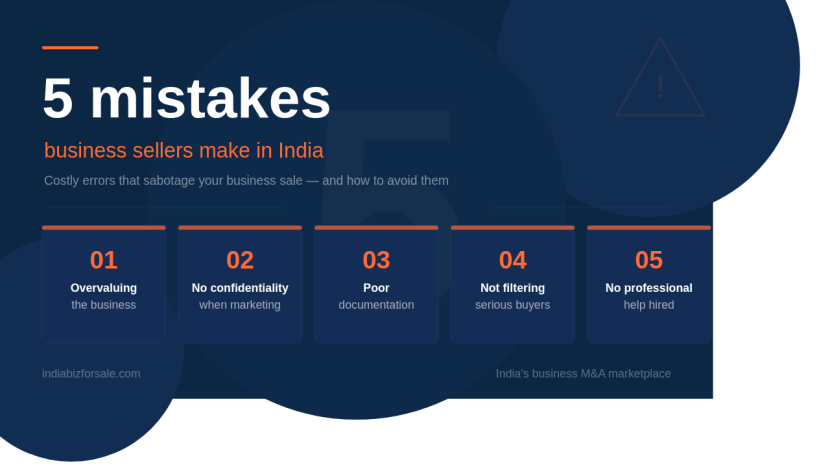
Let’s understand the top 5 common business mistakes that most owners make and how you can avoid when selling your business in India.
Because, You don’t have second chance to sell your business at good price. If you sell business in India, please make sure that you avoid these mistakes and you will sell your business quickly and at a good price.

If you are planning to sell your business in India, read this before you do anything else.
1. Lack of preparation:
They make the decision, put up a listing, and hope a buyer appears. What actually appears is a serious buyer who asks hard questions about financials, operations, growth plans, key-person risks, and the seller cannot answer them cleanly. The buyer walks. The seller wonders what went wrong.
What went wrong was preparation. Or the lack of it.
Selling a business in India is not a transaction, it is a process. And like any process, it rewards those who plan ahead.
What readiness actually looks like:
- 3 years of clean, audited financial statements including P&L, balance sheet, cash flow
- A business that does not collapse if you step away for 60 days
- Documented processes, not knowledge locked in your head
- A clear answer to every uncomfortable question a buyer might ask
- Weak spots identified and either fixed or explained
Sellers who prepare 6 to 12 months before listing consistently sell faster and for more. That is not an opinion, it is a pattern we have seen repeat itself across industries and deal sizes.
The fix: Treat your exit like a product launch. You would never launch a product without testing it. Do not launch your sale without preparing for it.
2. Wrong Valuation:
Your business is worth what a qualified buyer will pay for it. Not what you feel it should be worth.
This is the hardest truth in business selling, and it is the one most sellers in India resist.
You built this business. You sacrificed weekends, risked savings, managed crises no one else saw. Of course it feels like it is worth more than any number a buyer offers. But a buyer is not paying for your effort. They are paying for future cash flow, stability, and growth potential, and they will calculate that number using data, not sentiment.
Overprice, and serious buyers quietly disappear after the first conversation. You never hear why, they just stop responding.
Underprice out of urgency, and you close a deal fast but spend years wondering how much you left on the table.
How to arrive at the right number:
- Use recognized business valuation methods, EBITDA multiples for profitable businesses, asset-based valuation for asset-heavy ones, DCF for high-growth businesses
- Look at what comparable businesses in your industry and size range have actually sold for in India, not asking prices, but closed deals
- Get an independent valuation from a professional who has no relationship with you. Your CA is too close to give you a number a buyer will trust
- Price at a point where the buyer feels they are getting fair value — not a discount, and not a stretch
A well-supported asking price shortens negotiation, builds buyer confidence, and signals that you are a serious seller.
3. Inadequate information:
The buyer sitting across from you has done their homework. Have you?
Serious buyers, whether they are strategic acquirers, HNIs, or PE-backed operators — research before they engage. They know your industry’s average margins. They know what comparable businesses sold for. They may have already spoken to your competitors.
If you cannot answer basic questions about your own business without hesitation, monthly revenue, top customers, gross margin, growth rate, reason for any dip in year two, you hand them negotiating power immediately.
Worse, you create doubt. A seller who does not know their numbers signals a business that does not have its numbers. That is a red flag that no amount of goodwill can erase.
What you must have ready before the first call:
- Revenue and profit figures for the last 3 years, know them without looking
- Your top 5 to 10 customers and what percentage of revenue they represent (buyer concentration risk is one of the first things any serious buyer checks)
- Current team structure, roles, and any dependencies on key people
- Pending legal, tax, or compliance matters, disclose these proactively. Buyers find them in due diligence anyway, and discovering them themselves destroys trust
- A growth story: what has held the business back, and what could a new owner unlock?
The fix: Run mock buyer conversations before you take real ones. Ask a trusted advisor to grill you. Every gap you find and fill before a buyer does is money protected.
4. Reason For Sale:
Vague answers raise suspicion. Inconsistent answers destroy trust. Evasive answers end conversations.
“I just want to move on” tells a buyer nothing, and leaves them imagining the worst. Is the business declining? Is there a legal issue? Is a major client about to leave?
Buyers are not trying to trap you with this question. They are trying to understand whether they are walking into a problem you created and are now running away from.
How to answer this well:
- Decide your reason before you speak to a single buyer, and stay consistent. Every time your answer shifts slightly, it registers as a signal
- Be honest and specific. “I have been running this for 14 years and I want to pursue something in a completely different space” is credible. “It’s just time” is not
- If the business has a genuine challenge, address it directly and frame what a new owner could do that you have not been able to: “We have never had the distribution network to expand beyond Maharashtra, someone with that reach could double revenue in two years.” This turns a limitation into an opportunity
- Think about what you will do after the sale. Buyers feel more confident buying from someone who has a clear next chapter than someone who seems desperate to escape this one
A strong reason for sale does not just protect the deal. It protects your price. A buyer who trusts your answer negotiates less aggressively than one who suspects you are hiding something.
5. Non-qualified buyers:
Unqualified inquiries are not just a waste of time. They are dangerous.
They drain your energy, create false hope, and over weeks and months, make you doubt whether the business is actually sellable. Some sellers give up entirely because of this. Others get so exhausted that they accept a lowball offer just to make it stop.
This problem almost always starts with where you advertise.
Free classified websites, general social media posts, and broad newspaper listings attract volume, not quality. You get 80 inquiries. Three are from competitors fishing for information. Twenty are from people with no capital who are “just exploring.” Fifteen are from intermediaries who claim to have a buyer but have no verified mandate. The remaining forty-two never respond to your follow-up.
You spend three months on this and end up with nothing, except the growing suspicion that your business cannot be sold.
How to protect your time and energy:
- List on platforms built specifically for business buyers and sellers, not general classifieds. Platforms like IndiaBizForSale attract verified, investment-ready buyers with defined budgets
- Qualify early and unapologetically: What is their investment budget? What is their timeline? Have they bought a business before? These are not rude questions, they are standard due diligence from your side
- Get an NDA signed before sharing any financial details. Serious buyers expect this and comply immediately. Time wasters usually disappear at this step, which is exactly the point
- Watch for signals: Do they respond within 48 hours? Do they ask specific, informed questions? Are they willing to get on a call? These are the signs of a real buyer
- Maintain a pipeline of multiple buyers at once. One serious conversation is not a sale, it is a starting point
The fix: Fewer, better conversations. One serious buyer is worth more than a hundred curious ones.
Takeaways….
Every one of these mistakes is avoidable. None of them require exceptional skill or significant money to fix. They require preparation, honesty, and discipline.
Fix your preparation, and buyers take you seriously. Fix your valuation, and negotiations are shorter. Know your numbers, and you control the conversation. Have a clear reason for selling, and trust comes naturally. Filter your buyers, and your time goes to people who can actually close.
Selling your business is one of the most important financial events of your life. It deserves the same rigour you gave to building it.
List your business on IndiaBizForSale and connect with verified, serious buyers →
Keep this going please, great job!
Excellent blog you have here.. It’s hard to find high quality
writing like yours these days. I truly appreciate people like you!
Take care!!