

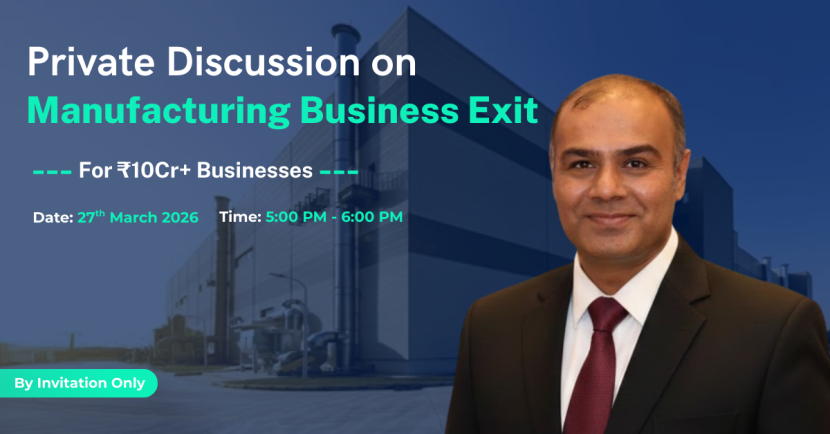
Last Friday (27th March 2026), we hosted an insightful webinar for manufacturing business owners on one of the most critical yet often overlooked topics, planning a successful business exit.
The session was led by our Co-Founder & CEO, Bhavin Bhagat, who brought to the table deep, real-world insights drawn from his experience of working on 100+ business transactions across investments, acquisitions, partnerships, and exits.
What followed was not theory, but practical, ground-level guidance every manufacturing entrepreneur should hear before considering an exit.
Here’s what he shared..
The Reality: Why More Promoters Are Thinking About Exits
Across India, many manufacturing businesses were built 10, 20, even 30 years ago, driven by first-generation entrepreneurs.
Today, a common pattern is emerging:
- The next generation is not interested in continuing the same business
- Promoters are exploring ways to unlock the value they’ve built over decades
But here’s the challenge,
Most businesses are not prepared for exit when the time comes.
First, Understand Who Is Buying Your Business
Before you think about selling, you need to understand who is likely to buy.
Bhavin broke it down into two clear categories:
1. Strategic Buyers
These are:
- Existing businesses in the same or related industry
- Professionals working in the sector who want to become entrepreneurs
They prefer acquiring an existing setup rather than starting from scratch.
2. Diversification Buyers
- Business families or individuals looking to enter a new sector
- Often driven by the younger generation seeking growth
Your positioning changes depending on who you’re targeting.
A Real Transaction Insight (And What It Teaches Us)
Bhavin shared a recent case where a family approached us to acquire a manufacturing business in an adjacent sector.
What stood out:
- They evaluated multiple businesses
- Visited facilities
- Studied financials and growth plans
- Took ~4–5 months to finalize one business
The takeaway?
Serious buyers exist, but they move only when they see clarity, structure, and confidence in the business.
What Actually Makes a Business “Sellable”?
This is where most promoters get it wrong.
1. Your Business Should Not Depend on You
Many promoters say:
“I’ll stay for 3–5 years after the sale.”
But buyers don’t buy that reassurance.
They look for:
- A second-line team
- Operational continuity without the promoter
In one example shared, the promoter had already moved abroad, and the business continued to grow under a partner-led team.
That alone significantly increased buyer confidence.
2. Stop Sharing Data. Start Telling a Story.
One of the biggest mistakes promoters make:
- Sharing financials
- Sending brochures
- Forwarding website links
But no context.
Bhavin emphasized:
“You are not just sharing information, you are positioning an opportunity.”
Buyers don’t just want numbers.
They want to understand:
- What this business really is
- Where it’s going
- Why it’s worth buying
3. Build the Right Exit Collaterals
If you want serious buyers, your documentation must reflect seriousness.
Key elements include:
Licenses & Compliance
- All manufacturing licenses
- Certifications
- Renewal timelines
- Any gaps and how they’re addressed
Product Portfolio (for product-based businesses)
- SKU-wise performance
- Historical sales trends
- Future projections
- Pipeline products
Customer Insights (for B2B businesses)
- Revenue contribution by customer
- Industry segments
- Longevity of relationships
And importantly, you can protect confidentiality by masking names while still sharing meaningful data.
4. Don’t Chase Every Buyer, Qualify Them
Not every inquiry deserves your time.
Bhavin highlighted two critical filters:
Capability
- Do they have the financial strength?
- Do they understand the business?
Intent
- Are they serious or just exploring?
- Are they aligned, or just gathering information?
Many promoters open their factory doors too quickly, only to realize later that the buyer was never serious.
5. Timing of Negotiation Can Make or Break the Deal
Another common mistake:
- Jumping into valuation discussions too early
Reality is:
- Buyers need enough data to value your business properly
- Promoters often recalibrate expectations after market interaction
The final price is not what you expect,
it’s what the market is willing to pay.
Some promoters wait years to reach their expected valuation.
That’s fine, if it’s a conscious strategy.
6. The Real Power Lies in Multiple Buyers
If there’s one lever that can dramatically improve your exit outcome, it’s this:
Create simultaneous interest from multiple serious buyers.
Why?
- Better negotiation power
- Faster decision-making
- Higher valuation potential
In one case Bhavin shared, multiple interested parties created strong competitive momentum, leading to a much stronger position for the promoter.
7. A Structured Exit Process Is Non-Negotiable
A successful exit is not a single event, it’s a process.
Bhavin outlined the flow:
- Business preparation
- Market outreach
- Buyer qualification
- Initial discussions
- NDA stage
- Detailed information sharing
- Due diligence
- Negotiation & closure
Skipping steps, or rushing through them, is where most deals fall apart.
Questions Answered Live During the Webinar
What are the top three factors that drive good valuation in manufacturing deals today?
Bhavin shared that the single most important factor is having multiple buyers interested in the business at the same time.
The top three factors are:
- Multiple buyers evaluating the business simultaneously
- A strong team in place
- Repeatable revenue from existing customers
He also added that intellectual property (IP), such as patents, can be an added advantage but only if it generates meaningful revenue. Otherwise, buyers do not assign a high premium to IP alone.
How should promoters decide between a full sale and a partial sale?
Bhavin explained that this decision depends entirely on the promoter’s goals.
If a promoter wants to gradually exit over a few years, a partial sale can be structured effectively for example:
- Selling 51% initially
- Then selling smaller portions over the next few years
This allows promoters to benefit from future growth in revenue and profitability.
If a promoter wants a complete exit, that is also possible. However, it depends on the preparedness of the business, and the timeline may vary accordingly.
If someone wants to exit a manufacturing business today, what should they fix in the next six months?
Bhavin suggested focusing on the following:
- Reviewing the client base, especially those with long or problematic receivable cycles
- Reducing dependency on customers with extended credit periods
- Strengthening repeatable revenue
- Building a stronger sales engine
- Improving overall business performance in the short term
- Working on team strength and documentation (collaterals)
He emphasized that improving performance in the last 6–9 months before a sale can significantly impact valuation.
What are the red flags that reduce buyer confidence during due diligence?
Bhavin highlighted that lack of transparency is one of the biggest red flags.
Every business has challenges, but promoters should not wait for buyers to discover them.
Instead:
- Share issues early
- Be clear and upfront
If buyers discover inconsistencies themselves, it creates doubt about the entire business.
He shared an example where a buyer visited a factory and found fewer employees than what was communicated. This created doubt in the buyer’s mind about the accuracy of other information.
Such situations may have valid explanations, but if not clarified, they can affect trust.
Anything that creates doubt in the buyer’s mind should be addressed early and clearly.
The Bottom Line
Manufacturing businesses have strong demand in today’s market.
But demand alone doesn’t guarantee a successful exit.
The promoters who succeed are the ones who:
- Prepare early
- Build independent teams
- Present structured, thoughtful information
- Engage with the right buyers strategically
As Bhavin put it during the session:
“You’ve spent years building your business.
The exit deserves just as much planning.”
If you’re even thinking about exiting your manufacturing business, don’t wait for the “right time.”
Start preparing now, because well-prepared businesses don’t just sell… they command value.